What’s the proof?
I guess Rick is seeing something different from that URL.
On my mac it asks if I want to use Apple maps to see it, if I say ‘no’ then Firefox is empty. If I say ‘yes’ the Apple Maps opens and I don’t see anything saying the map is from Google.
If I open the link on my Android, Chrome opens up Google maps.
1 Like
Open Apple maps on a PC, it simple shows the Google interface.
To show a Apple content you must use the beta version.
And the Beta version uses a lot of fused mapping infos using openstreetmap tech + TomTom traffic data + lots of fragmented data from several governments.
The Google data uses Google world data mapped by Google (that’s a huge thing) + lots of other info too, but not just lots of infos, I mean LOOOOOTTTSSSS of more infos 
Maybe someone focusing in some streets of Texas or California think that Apple Maps are great, and maybe it can be, not sure, but when you compare things looking at Singapura, Taiwan, Brazil, South Africa, Malaysia, and the rest of the world things start to get different.
Sounds like Android is intercepting the call to maps.apple.com and redirecting to Google Maps.
And if you think that Apple intends this, I just happen to have a bridge for sale that might interest you.
2 Likes
Ah. I’m on mobile iOS and none of this happens as you’re describing.
2 Likes
Not an Android thing.
AFAIK any non Apple device is served through Google by Apple.
Except, as said, when using their beta.
From what I read, the Apple maps need an app to open. If you can’t have Apple maps on your PC/Android it opens Google maps.
Apple maps beta can be open on a web browser, no need to use a maps app.
Of course, we are off-topic.
2 Likes
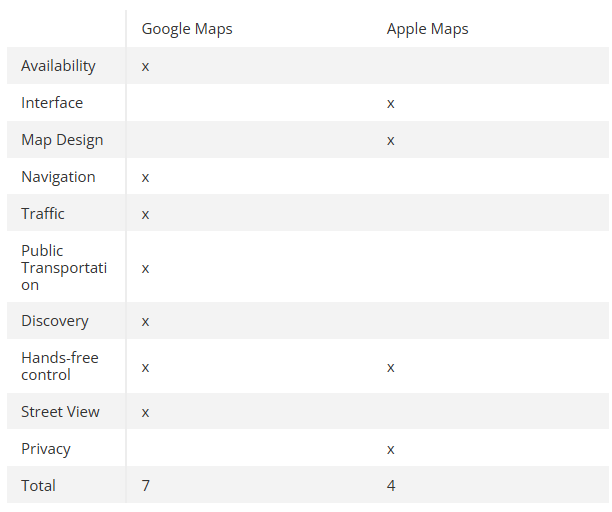
Kind of. We entered into this silly conversation to demonstrate that “the best option” is not detected easily based only on one or two biased sentiments about whatever. A deeper analysis needs to be done. We must refrain of things like “I like Apple more” and serve something that works great for a broader public. 
Notably they didn’t include category for accuracy. I keep getting bitten by Apple Maps sending me to the wrong place - happened just last week. It’s maddening.
I can remember the early days of Google Maps when it suggested you drive across the Atlantic to get from NYC to London, England, and which pier one should drive off of.
2 Likes
They gave a win for Google on the navigation category, this covers what you said.
I made lots of funny routes those days. Today I just collect few funny street views like the inside of the TARDIS

Not necessarily. You can get good or poor directions to a place - for example, Apple Maps tried to send me on a meaningless loop recently (see attached screenshot).
Inaccurate information gave me excellent directions to a residential street where there definitely was not a pharmacy.

Much of this is dependent on your region. Personally I’ve found that Google has done a more consistent job collecting map data from the areas I frequent. Apple Maps didn’t even have my street on it until 2020, and it’s not like I’m in the middle of nowhere, I live in Los Angeles.
They called a walk in a square like if it was the street that stopped 50 m near that… No car will never be able to run there.
And that Park and the streets, etc. all around can be see with streeet view (in case you suspect something strange…
here is a sidewalk on one side and steps (fairly spaced) on the other, and it opens onto a sidewalk on the other side! Bicycle can go there, but that is all, no car.
Errors are everywhere.
It’s interesting—almost ironic—that Xojo has chosen Apple as its reference point for integrating AI. Of all the major tech companies currently working with LLMs and intelligent assistants, Apple is arguably the one that has handled it the most poorly so far.
While others—OpenAI, Google, Microsoft, even Meta—have embraced the complexities of AI head-on and delivered powerful, useful integrations, Apple showed up late to the party with what is, by most accounts, an underwhelming and severely limited implementation. The very company that once set the gold standard for usability and innovation seems to be playing it overly safe, wrapping a half-baked product in marketing polish and calling it “Apple Intelligence” as if renaming the problem solves it.
So if Xojo is modeling its own AI assistant after that—carefully avoiding the term “AI,” and placing more weight on branding than capability—it’s a bold move, but perhaps not in the way intended. Choosing the company that currently ranks last in practical, real-world AI execution as your benchmark could be seen as a grand idea in theory, but questionable in practice.
That said, I sincerely hope Xojo proves me wrong. If the assistant turns out to be thoughtful, capable, and genuinely helpful—despite the cautious branding—it could still shine. But let’s be clear: success will come not from what it’s called, but from what it does. And for that, Apple—at least so far—has set a surprisingly low bar.
6 Likes
I don’t know what/how things are being developed right now when it comes to AI but please make it a plugin and not a integrated feature. I don’t want AI in my IDE.
I know some people are businesses who want it to increase output and make their job easier. However I’m a hobbyist (who also buys my license) and Enjoy coding and learning programming in Xojo. I use AI at work and want nothing to do with it for my home projects.
If it was a plugin then everyone gets what they want. Besides most AI doesn’t even need the integration, you can just say “GPT Xojo me a app that does a thing” and you copy paste the output.
Honestly if AI was just integrated into all of Xojo I think whatever version was before that would be the last Xojo I would ever buy.
To be clear i use AI, I don’t hate it completely but I don’t want everything to be completely covered in it with no user choice.
2 Likes
Wouldn’t it be nice if it were that easy? 
It will most likely be optional. The community is still too divided on the pros and cons of AI support within the IDE.
But let’s get to it, because it has to be. That’s not my opinion; it’s a fact that every company in this sector has to face today…
1 Like
I completely understand the concern about not wanting AI “everywhere” or being forced into workflows that feel unnatural, especially when programming is a personal or hobby pursuit. However, I think there’s a fundamental misconception here about what “AI in software development” actually means—and what makes it useful.
AI doesn’t work by simply telling it “make me an app” and magically receiving production-ready code. That kind of prompting only scratches the surface and rarely leads to anything maintainable or even correct. Real productivity gains from AI come not from replacing the developer, but from augmenting the development process at a much more granular level.
AI is, at its best, an incredibly sophisticated and context-aware form of autocomplete. It doesn’t know what you’re building unless it can see your code. It can’t suggest good, idiomatic solutions unless it understands the surrounding context—your variable names, your method structure, your architectural choices. That level of insight and assistance is only possible when the AI is embedded in the IDE, with direct access to the codebase and editor.
It’s not about turning software development into button-click automation. It’s about streamlining common tasks, catching bugs as you type, generating boilerplate code based on patterns, and offering smart suggestions that are tailored to your exact context—not just generic “GPT” snippets.
In short, AI in the IDE is not about replacing developers. It’s about making developers—whether hobbyists or professionals—more efficient, more confident, and less burdened by repetitive or boilerplate tasks. The goal is to support creativity, not to bypass it.
So while I completely agree that AI should not be forced on anyone, the real potential of this technology only becomes evident when it’s available where you actually write code. As a plugin? Perhaps. As a fully integrated optional assistant? Even better. But AI outside the IDE is like spellcheck outside a word processor: much less useful than it could be.
5 Likes