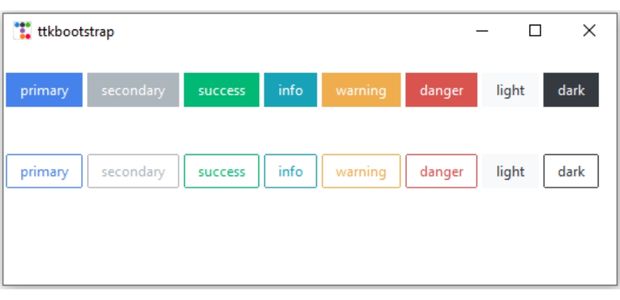
I’m guessing you’re ( many years ) behind the times. Ttk added styling/themes to tkinter which means you can make it look pretty much however you like:
I am talking about Event Driven code. Like the more than 15 Events that are associated with a Push Button. In Xojo it is very easy to associate code with these events and easily access them for editing.
Freely moving Controls around a window in the IDE. Aligning them. That sort of thing.
I enjoyed the tutorial and Pygubu Designer is very cool.
IMO it is vastly more complicated and less flexible than the Xojo GUI designer. The Events associated with a TextField Control, for example, allow you to much more easily control things like what the user types into that Control. Again you have many ready to code Events that are associated with the Control.
The Widgets (Controls) in Pygubu Designer are arranged on a Row/Column Grid. In Xojo GUI designer, you just move them around with the mouse to the exact pixel position that you want. You are not typing out their Row/Column position.
With Xojo you are not generating huge XML files and code files that you have to manage. It is all hidden and automatic.
I am a Python fan. But creating GUI’s for Python is simply a lot harder and complex than it is for Xojo. I wish that Xojo was descended from Python rather than Basic. But I love Xojo for the ease and speed with which I can create GUI’s.
Python is a general purpose, cross platform, high level programming language that supports OOP, similar to Xojo. There is undoubtedly over-lap in the potential audience.
Just to point out, it is not the tool or the language that does not fit the OPs needs.
There are only two ways a product declines. It may fail to retain existing customers or it may fail to acquire new ones. In either case customers are lost one purchasing decision at a time. As the customer base diminishes so does the reputation of the product, one opinion at a time.
Once more. It’s not the tool or the language that is the problem. The OP ‘wants’ to use the tool. The OP’s stated views suggest what is not right for him is the value proposition. A not entirely uncommon complaint levelled towards Xojo.
Yes we can all invent irrational scenarios to further our own proposition, like your corn-flakes purchasing habit. Prime number obsession is hardly a common affliction amongst the corn-flake buying population though, and so there is no business catering for it. Value on the other hand is a concern for virtually the whole population and getting the proposition wrong will sink any viable business.
I sympathise with the OP. Xojo is the only paid software I am actively using in my business that I do not keep up to date despite wanting to. Why don’t I renew? Mostly because I find it too difficult to buy.
Thank you for appearing to refute my points while actually agreeing with and reinforcing them.
And yet, here we are some 26 years later, discussing Xojo with a wide and diverse developer community. I’d say they’re doing something right - seems viable to me.
Tkinter gives you three options for layout manager - Grid, Pack and Place. The tutorial made use of the Grid layout manager but both of the alternatives are supported by Pygubu too.
Python has a lot of options for creating a GUI and several of those have visual designers available if that’s important to you…
I refuted a few things. Care to explain how you think I was reinforcing your point?
What even is your point? Like it or lump it. I think that is a poor attitude for doing business in the 2020s and it certainly will not help grow a customer base or community. If anything you are only reinforcing my suspicion Xojo is on the long tail.
I have only been around RB/RS/Xojo since 2003. I disagree with you. The community is less diverse and narrower than ever I remember previously. A stark contrast to the estimated 8,200,000 users Python acquired over a similar period.
There’s a LOT of money to be made on the long tail. The iTunes Music Store, back when it debuted in the early 2000s, was explicitly designed to take advantage of this idea. And I’ve personally worked at one successful company whose business model was also based on the long tail.
So, yeah, Xojo doesn’t have as many users as (insert very popular open source language here). That’s fine. Big numbers aren’t always the goal. It’s also just fine to have a smaller community.
That is actually one of the problems. Researching the “options”. Trying to figure out which is best and which is likely to be supported over time. All this adds complexity.
Python is free. I invite anyone to try and make an application with any sort of sophisticated UI in Python and claim that it was easier than doing the equivalent with Xojo. In my experience Xojo is far and away better for this sort of thing.
Python has advantages for an extensive collection of libraries, mostly open source, that make possible use of many sophisticated tools. And I happen to like the language itself — obviously many others do as well. But if the task at hand is to write a stand alone application — with more than a barebones UI — I don’t think it is even close.
I am astonished that you apparently think otherwise. I presume you are very familiar with Xojo. Anyway, if that is the case, it is great for you. Python is perfect for you. Begone.
Mining the long tail generally involves exploiting previous investment and sunk cost. Suppliers can make money but it is not a great place for customers to be.
iTunes is an interesting example for you to choose. The crux of the iTunes model was the leveraging of digital delivery to overcome the traditional inventory limitation of physical retail sales. By reducing the inventory cost to near zero, Apple negotiated a margin to sell more things to more people who wanted to buy them, at a price they were prepared to pay. The renegotiation created growth where previously there was none, giving many forgotten bands a new lease of life with younger audiences.
I agree, it is not about big numbers. It is about growth. Perhaps the biggest change in post internet economics is the shift from margin to customer acquisition. In the 2020s a business that is not growing is failing, unless your goal is semi-retirement I guess.
The Python comparison is not a zero sum. The market research for iTunes was performed by Napster and others. It was evident from the large number of people engaged in piracy and the lengths they were going to, that a convenient, legal and affordable alternative would capture some of that audience. There seems to be some agreement here that Xojo is more convenient than Python.
I’m all for selling more things to more people who want to buy them at a price they are prepared to pay. If you are content to wallow I don’t think we are going to agree. I am too young to retire and Inventing reasons to not do business is alien to me I am afraid.
Don’t point at me, because it’s not my business plan you take endless issue with, it’s Xojo’s.
Finally, I’ll just point out that you almost certainly don’t actually have sales and usage figures for Xojo, and if I’m correct in this, have no actual basis for your argument other than your own arrogant presumption.
Perhaps as you mature and gain more experience, you will develop a more nuanced approach to life and happiness that is not based on outdated notions of what defines success.
You don’t appear to want change. You don’t appear to want the Xojo user base to grow. I call that wallowing. If you have a better word for it please let me know. Resigned maybe, is that more acceptable.
I don’t take endless issue with Xojo’s business model. A few times a year at most I ponder how Real Basic managed to not be more widely adopted in the face of astounding growth in market interest. It’s a glass half full thing I guess. Some people look for reasons why they can’t do things, others look for ways they can be done. I’ve never been good with can don’t, as my staff would no doubt tell you. I find it frustrating and depressing. Sorry about that.
Honestly, there is no need to see sales figures to estimate which way a public facing business is going. That long tail has general characteristics that are difficult to hide. Prices rising, head count declining, an ageing customer base, active users sat on old licenses, and so on. Yes there is a small possibility that somehow Xojo is special but it is a vanishingly small one.
Hah! You don’t have a clue who I am, make a statement like that and call me arrogant. Good one. 58 today by the way.
Something you clearly haven’t done ( not recently at least ). That was my point really.
I was at one time. One of the things that made me look elsewhere was Einhugur pulling the plug on their StyleGrid. It was hard to create much more than a rudimentary UI in Xojo without such third-party plug-ins. Plus Xojo’s widgets suffered flicker on Windows and you’d also need to add code to resize them on Linux otherwise they’d display incorrectly.